

Two tennis greats were saved from the ice.
It is amazing the number of real-life stories that have come out of that tragic event in the frozen darkness of the Northern Atlantic, where an iceberg sank, the RMS Titanic, the pride of the North Atlantic and the Regency age. The iceberg tore the ship open as if it were a tin opener. Steel groaned, lights flickered, as the great ship slowly sank into the sea. It carried down with it over fifteen hundred lives, shattered dreams, and a lesson to the arrogance of a new age that believed the Titanic was invincible.
However, that dreadful day has bought us a series of amazing stories of personal courage, confidence and survival. This is another story that has come from that unbelievably dreadful day. It appears that as the RMS Titanic worked its way across the Atlantic towards the iceberg, there were two tennis greats on board, who until then didn’t know each other, 21 year old Richard Norris Williams and Karl Behr, a 26 year old former Wimbledon finalist.
Then it hit the iceberg!
They both ended up in the lifeboats.
Karl Behr survived in Lifeboat 5, and once they were collected arrived on the deck of the RMS Carpathia, he immediately joined the “Committee of Survivors,” helping organize clothes and food for those who had lost everything. He survived virtually undamaged, on the face of it, but the horror of the events stayed with him for the rest of his life.
 However, by the time Richard Williams arrived on the RMS Carpathia he was in a much worse state. This was because he had been assigned to Lifeboat 14, one of the last boats to be launched and one of the few that returned to search for survivors in the water. It was Fifth Officer Harold Lowe, who made the brave decision to return to the site of the sinking after the ship had gone down. Richard volunteered to help, with the result that he spent many hours in freezing conditions, assisting with the rescue of survivors. Unfortunately, this meant that his legs were submerged in icy seawater for so long that by the time the lifeboat was picked up by the RMS Carpathia, Williams was suffering from extreme frostbite.
On the Carpathia the doctors come up with a terrible decision.
This was the kicker, when the medics on the RMS Carpathia examined him, they decided that both of his legs were badly damaged. They recommended immediate amputation to prevent gangrene and save his life.
Now, Williams wouldn’t let them do this, as he would then be faced with the end of his life as an athlete, so the 21-year-old famously refused. He told the doctor, “I’m going to need these legs” and immediately decided to exercise his legs despite intense pain, he was convinced the movement would restore his circulation. Therefore, against the advice of the doctors he persevered, and remarkably, his legs gradually recovered. This decision was pivotal not only to his survival but to his future career.
As Karl Behr was helping the survivors he watched as a very determined Richard continued walking around the deck and inevitably, they became friends.
As a result of all his walking by the time they reached New York his legs were actually reacting, and his circulation was coming back, this allowed him to get back to training.
His first match in America
His training was going so well that he decided 12 weeks late to enter the Longwood Challenge Bowl in Boston in July 1912.
Who do you believe he came up against, Karl Behr!
In front of 1500 spectators, they fought out a gruelling, five-set marathon. Interestingly, Behr, the seasoned veteran, initially struggled but eventually he was able to wear down the 21-year-old Williams. Behr won the match: 0–6, 7–9, 6–2, 6–1, 6–4. Even though it was Williams’ first defeat on American soil, the fact that he was competing at all, let alone pushing a Davis Cup veteran to five sets, could be described as a medical miracle.
What happened after this to these two talented tennis players?
Richard Norris Williams
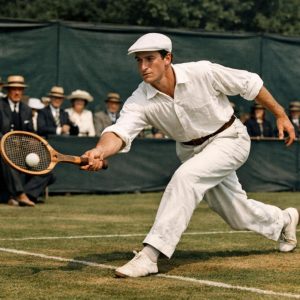 He started a successful tennis career, two years after the Titanic disaster in 1914, he won the U.S. National Championships, (which we now call the American Open), a feat he repeated in 1916. With his aggressive style and mental toughness, forged by survival, he became a tennis legend.
Then he served in World War I, in fact, so bravely that the French awarded him the Croix de Guerre. The Croix de Guerre (French for “Cross of War”) is a military decoration awarded by France to recognise acts of bravery in combat. After the war, back on the tennis circuit he won a gold in the 1924 Paris Olympics. The once he retired, he continued his involvement with tennis, eventually becoming the President of the International Tennis Hall of Fame. Throughout his life, Williams remained a figure of quiet dignity, defined more by his enduring sportsmanship and resilience than by the catastrophe he survived.
In his private life he married Jean Haddock on January 11, 1919, in Paris, France. Together they had four children but unfortunately Jean died in 1929 at the age of 38. On her death, Williams married Frances West Hemsley Gillmore on October 2, 1930 and they had two children, he remained married until his death in 1968.
Karl Behr
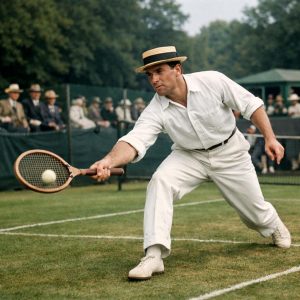 Meanwhile, Karl Behr continued his already successful tournament life after the Titanic disaster, showing his athletic excellence and talent. In 1914, he joined the U.S. Davis Cup team, alongside Richard. Behr remained a top-ranked tennis player until 1915, later earning induction into the International Tennis Hall of Fame.
After service in World War 1, he had a successful banking career as vice president of Dillon, Read & Co. along with holding major directorships. He married Helen Newsom in 1913, unfortunately for most of his life he privately grappled with survivor’s guilt, which, I assume, is to be expected.
Behr passed away in 1949, he is now remembered as a notable sportsman who is remembered for rebuilding a full life following tragedy.
Conclusion
The Titanic disaster gives us a chance to examine the personal effect such an event had on two well known passengers. It is an interesting story that shows how the same event can produce different human reactions and long-term effects. On the face of it Karl had the easiest ride, but it stayed with him for the rest of his life. Richard, on the other hand showed remarkable strength of mind to keep his legs, an amazing feat that allowed him to go on to achieve so much.
This is why I find history so interesting.
10 Questions for discussion:
- What was the Titanic, and why was its sinking such a shock to people at the time?
(Think about ideas of technology, progress, and “invincibility”.) - Who were Richard Norris Williams and Karl Behr, and why is it unusual that their story is linked to the Titanic?
- How did the experiences of Williams and Behr during the sinking differ, even though both survived?
- Why was Richard Williams’ time in Lifeboat 14 especially dangerous, and what brave decision did he make?
- Why did the doctors on the RMS Carpathia recommend amputating Williams’ legs, and why did he refuse?
- What does Williams’ decision to keep exercising his legs tell us about his character and mindset?
- How did the Titanic disaster affect the later lives and careers of both men in different ways?
- Why do you think Karl Behr, who survived with little physical injury, struggled emotionally after the disaster?
- In what ways does this story challenge the idea that survival always means life returns to “normal”?
- What lessons about courage, resilience, and the human response to tragedy can we learn from this story?
Other Web sItes who can learn more about these two:
https://www.si.com/tennis/2015/04/20/si-vault-richard-williams-karl-behr-titanic-tennis
https://jannaludlow.co.uk/Tennis/Titanic.html
https://www.mirror.co.uk/news/uk-news/titanic-survivors-went-on-to-become-tennis-783043